
Scaling a service business means increasing its capacity and profitability without adding the same level of work to the owner’s schedule. By documenting processes, developing managers, tracking key performance indicators (KPIs), standardizing sales, protecting gross profit, and building consistent operating routines, owners can grow their companies without becoming the bottleneck. The goal is to build a business that delivers reliable results through its people and systems, not constant owner intervention.
Understanding how to scale a service-based business starts with creating repeatable processes, developing managers who can make decisions independently, and tracking performance so the company can take on more work without increasing the owner’s workload.
Your service business is growing, revenue is increasing, the team is expanding, and the schedule is full. Yet you’re working longer hours than ever, handling customer complaints, approving estimates, resolving staffing issues, and answering questions employees should be able to manage themselves.
This is a common problem for home service business owners. Growth creates more opportunities, but it also exposes weaknesses in scheduling, communication, hiring, sales, and accountability.
The difference between growth and scaling matters. Growth often means adding revenue alongside additional labor, costs, and complexity. Scaling means increasing the company’s capacity to generate profitable results without requiring a corresponding increase in the owner’s involvement.
If every new customer, employee, or operational challenge demands more of your time, the answer isn’t necessarily to work harder. It’s to build better systems.
Understanding how to scale a service business starts with identifying what limits the company’s capacity. For many contractors, the biggest constraints are owner-dependent decisions, inconsistent processes, and managers who lack the authority to resolve routine problems. Addressing these constraints helps the company handle more work without making the owner responsible for every additional decision.
When every important decision goes through the owner, work slows down. Employees wait for approvals, managers escalate routine problems, and customers depend on one person to get answers.
The owner may feel indispensable, but this dependency limits how much the company can handle. Adding technicians, salespeople, or service vehicles won’t solve the problem if the owner remains responsible for coordinating every part of the operation.
Informal knowledge might work when a business is small. As the team grows, inconsistent estimating, scheduling errors, missed follow-ups, and uneven service quality become more expensive.
Without documented procedures, the company relies on individual memory rather than a repeatable operating system. Employees may complete the same task differently, while managers spend time correcting mistakes instead of improving performance.
Additional jobs can increase payroll, material costs, callbacks, and customer service demands. If pricing is weak or jobs take longer than expected, the business may become busier without becoming more profitable.
Revenue growth without operational control can leave the owner managing a larger, more complicated business without improving its financial results.
Promoting an employee to manager doesn’t solve owner dependency if that person still needs approval for every meaningful decision.
Managers need clear responsibilities, decision-making authority, and accountability for results. Without these, the owner remains the default problem-solver even after a management team is in place.
Calls made, leads generated, and jobs completed are useful operational measures. However, owners also need to understand conversion rates, gross profit, labor productivity, cash flow, and the time they personally spend running the business.
A business cannot scale reliably when the owner remains its primary operating system.
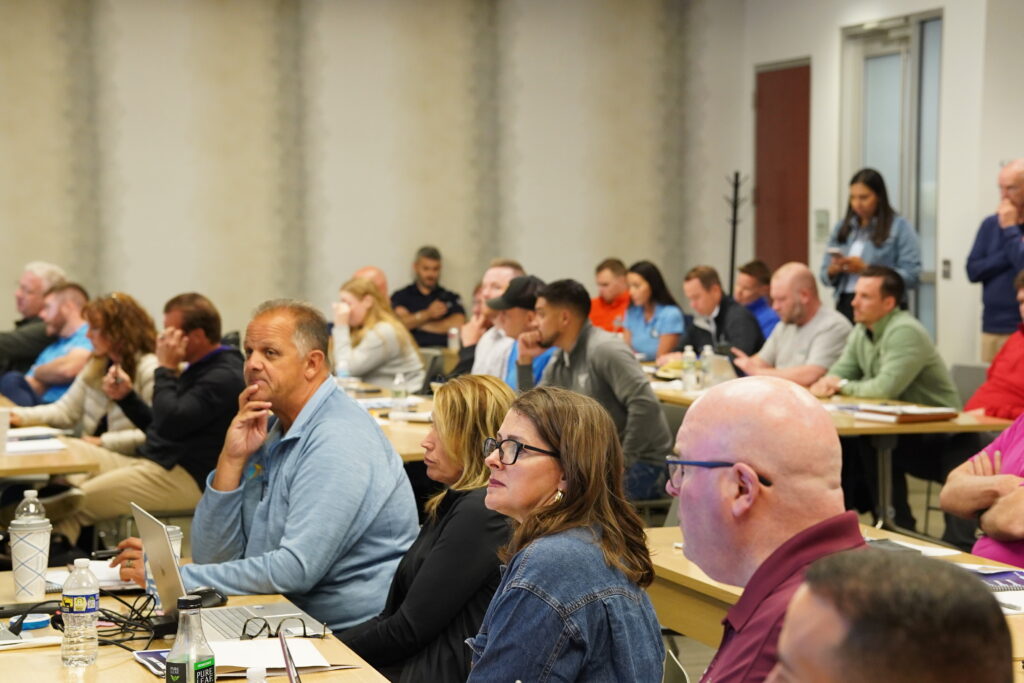
Scaling means building the capacity to handle greater demand while maintaining service quality, operational control, and healthy margins.
A scalable service business has repeatable sales and service processes, clear responsibilities, capable managers, reliable performance reporting, and documented procedures that support training and accountability. It also delivers a consistent customer experience as the team and workload expand.
For owners researching how to scale a service based business, the priority is to create repeatable operations before expanding the workload. Adding employees or taking on more customers should build on an operating structure that already works, rather than expose weaknesses that the owner must personally correct.
Scaling doesn’t mean the owner must disappear from daily operations overnight. It means reducing dependence on the owner for routine decisions while preserving their role in strategy, leadership, and financial oversight.
Before changing the business, understand how you spend your time. Track your activities for a week or two and group them into strategic work, management responsibilities, and routine operational tasks.
Strategic work includes financial planning and growth decisions. Management work includes coaching employees and reviewing performance. Routine work includes scheduling changes, repetitive approvals, and customer escalations.
Identify the tasks that repeatedly interrupt your day. Decide which can be eliminated, automated, documented, or assigned to someone else.
List the recurring tasks that pull you away from higher-value work. Give each task a long-term solution instead of continuing to handle it personally.
Establish a baseline for your weekly working hours before making changes. This will help you determine whether the new systems are genuinely reducing your workload or simply shifting your responsibilities to different parts of the day.
Create repeatable workflows for lead intake, sales, estimating, scheduling, job execution, quality control, invoicing, collections, customer complaints, and employee onboarding.
Start with activities that frequently create mistakes, delays, or owner involvement.
Good documentation should explain what needs to happen, who is responsible, what standard must be met, and how performance will be measured. A procedure employees cannot understand or follow won’t reduce the owner’s workload.
Practical example: An HVAC company taking on more jobs without extending the owner’s hours.
Consider an HVAC company where the owner handles scheduling problems, approves estimates, answers technicians’ questions, and follows up on unsold jobs. The team has room to take on more work, but every additional job creates more decisions for the owner.
Instead of hiring more people immediately or working longer hours, the company addresses the operational bottlenecks.
With these changes, the company can schedule and complete more jobs using its existing operating structure, provided it has sufficient labor, equipment, and service capacity. The owner spends less time resolving routine problems and more time reviewing profitability, developing managers, and planning growth.
The improvement comes from removing operational bottlenecks, not from asking the owner to work harder. Also, discover about can your business run without you.
Managers must take ownership of outcomes.
Each manager must have a clear role and set limits to what they can approve. They should also be empowered to solve issues within these boundaries. They should also be trained how to analyse, decide and report.
Delegation does not mean letting go. Employees should know clearly what is expected of them and have the correct resources, decision making power and accountability.
Results should be regularly reviewed. If managers keep to escalate the same issues then decide if they require further training, improved processes or more empowerment.
A useful KPI system shows whether the business is producing the results it needs. Choose a manageable set of measures and assign ownership for each one.
Business Area | Example Metrics |
Sales | Lead conversion rate, average ticket, estimate close rate |
Service operations | Jobs completed, technician productivity, callback rate |
Financial performance | Gross profit, EBITDA, operating expenses, cash flow |
Marketing | Cost per lead, qualified leads, marketing return |
Team performance | Employee retention, training progress, productivity |
Customer experience | Customer satisfaction, complaints, repeat business |
Owner workload | Owner hours worked per week, hours spent on routine operations, decisions requiring owner approval |
Metrics only create value when someone is responsible for the result and knows what action to take when performance falls short.
Track owner hours worked per week alongside job volume, gross profit, and financial performance. Establish a baseline before changing processes, then compare results over time. If the company is completing more jobs while owner hours remain stable or decrease, that is evidence that operating capacity may be improving without increasing the owner’s workload.
If the owner’s hours continue to rise, investigate which responsibilities, approvals, or customer relationships still depend too heavily on them.
Use the numbers to identify problems early, coach managers, and make decisions based on business performance rather than assumptions.
Sales become limited if they are reliant on the owner, or one high performing sales person.
Have a clear set process for each stage of the sale (from initial contact, to estimation, presenting options, overcoming objections and follow up). Train your employees by giving real examples of customer conversations, estimation and sales outcomes.
Monitor your conversion rates and profitability. You might be creating extra pressure within the business by having a team who can win more work at low margins.
To have a repeatable, teachable, measurable and improvable sales process.
Increased sales may seem like a good thing but if things aren’t managed correctly there can be a reduction in your margin. This can come from poor estimation, too many labour hours, waste, rework and unprofitable jobs.
Look at profit at the job level, ensure that you are still making a profit on the price, monitoring labour hours. Investigate any regular rework. As you grow, look at your overheads as you will be adding more staff, vehicles, equipment and locations.
You want to get stronger financially as you grow.
Tools such as booking systems, automated reminder systems, lead routing, invoicing, payment reminders and KPI dashboards can help reduce this manual work.
However, you want the tech to help your process. If you are automating a bad system it will just cause errors quicker.
Firstly identify what the issue is within your operations. Then decide how you want to change your process and select tools so your staff can carry out the process consistently. This will help reduce manual work and provide more clarity. Don’t add more tools for the owner to manage.
A consistent management cadence helps owners stay informed without becoming involved in every issue.
These meetings should help managers own performance and resolve problems. The owner should use them to lead through people and numbers, not reclaim every operational decision.
A reduction in working hours can be a good indicator, but to ensure sustainable growth you need to make sure that the company is performing better and becoming less reliant on the owner.
Look for a reduction in turnover and gross profit along with healthy EBITDA and cash flow. Are managers dealing with day to day issues without needing to involve the owner? Is the customer experience remaining the same?
New staff should be able to easily follow processes in place and the company should still be performing well when the owner is not present.
Monitor how many hours the owner is working per week. If hours are reducing but the service quality, profitability and customer satisfaction is also reducing then they may simply be neglecting key areas of the business. A real improvement will mean that the company is consistently performing well with less direct involvement from the owner.
Set a benchmark and look at how things have changed to ensure you’re seeing real improvements rather than just less work being done.
Hiring more people: A lack of clarity around roles and inefficient processes are not solved by hiring, but may mean you have more management issues.
Delegation without authority: People are still entirely reliant on the owner.
Revenue driven: This will result in unprofitable activities consuming time, money and resources and not creating a better business.
Software before process: Technology can’t replace clear processes, staff training and accountability.
Maintaining strong relationships with the owner: Your customers, staff and vendors are entirely reliant on the owner meaning the business is hard to run or handover.
Scaling before you have a solid process in place: Adding more locations, services and/or team members could cause your issues to escalate as the business model is not scalable.
These systems can improve your business.
By having documented processes, efficient managers and financial controls you will be able to see the best growth opportunities which will lead to increased performance. If you have clear responsibilities then it will be much easier to measure and improve.
This will also make your business more transferable. A business which is predictable and doesn’t rely on the owner will give a lower risk when selling.
You will be able to be independent by having your own strategy, exploring new opportunities, developing future leaders and being ready to sell.
The aim isn’t to eliminate the owner from the business but to have a business which can run independently.
You need a system that ensures your team are working consistently and that you have clear accountability from your managers in order to scale your service business without increasing workload. The aim is an increase in capacity but to maintain margins, ensure high quality service and reduce owner intervention.
Identify all owner reliant tasks. Document key processes, delegate authority to your managers, use performance measures, create consistency in your sales process, maintain gross profit and create consistency in your management. Measure how many hours per week your owner is working to ensure they aren’t working extra hours to grow your business.
Build It To Sell It helps AI home service business owners strengthen leadership, accountability, sales, and operations so they can improve profitability, reduce owner dependency, and build scalable, transferable companies.
If your business cannot grow without taking more of your time, start by fixing the systems that still depend on you. Build a business worth owning today and worth selling tomorrow. Also, review how much my contracting business worth.
To scale your service business you want to look at putting in place systems for sales and service. Ensure processes are documented and managers are developed. You will also want to ensure you have financial and operational KPIs in place and ensure gross profit is maintained. Tracking your owners hours worked per week will also help understand if your business is scaling up and not increasing the workload of the owner.
You want to start tracking how much time you are spending and find out what tasks you are repeating. Document these processes and delegate to competent team members. Define boundaries for decision making and ensure you have a consistent management system in place to review outcomes. Tracking your hours per week will help understand if you are being less involved.
Having an owner dependent business can be an issue. If you are having to make regular decisions, manage customer relationships and solve problems within the business then you will struggle to scale up efficiently. By developing your managers to be competent, having repeatable processes and tracking owner hours per week can help overcome this.
Most service businesses will want process in place for sales, scheduling, dispatch, delivery and quality control. Invoicing and collections, recruitment and customer service. Clear management roles, financial reporting and KPIs.
If your business currently has consistent profitability, repeatable processes, competent managers to make regular decisions and reliable performance metrics then it will be in a better position to scale. Having these in place before adding new locations, teams and services will help reduce the risk of increasing existing issues.

Build It To Sell It™ is an operator-led growth platform built exclusively for home service business owners who want to create stronger, more profitable, and more valuable companies. Rather than offering generic business advice or motivational coaching, Build It To Sell It™ provides proven operating systems, hands-on coaching, peer accountability, and real-world strategies developed by entrepreneurs who have successfully built, scaled, and sold businesses.